.png?ph=2d2ea667ab)
Does Timbre Become Pitch as We Listen More Closely? Listening to Chaya Czernowin’s fardanceCLOSE [English ver]
Chaya Czernowin composed ’fardanceCLOSE’ in 2012 to celebrate the birthday of Peter Hanser-Strecker, who led the music publisher Schott Music for many years and made a major contribution to classical music.
In her preface to the score, Czernowin describes two strange “dances.”
In one, you stand alone at night and hear dance music carried on the wind from a distant party. Its remnants have become so entangled that you can no longer tell what music you are hearing.
The other dance is too close. A heavy beat pins your ears in place until all you can perceive are the details of its distorted repetitions.
Neither can be danced with the feet. Yet the imagination tries to dance to them. Both, she writes, unsettle our sense of what is “far” and what is “close.”
That is precisely what happens in the piece.
Here, “far” and “close” are more than differences in volume or expression, more than an instruction such as 'lontano'.
【Listen on YouTube :Chaya Czernowin's fardanceCLOSE (2012) Pianist - Alfonso Gómez】
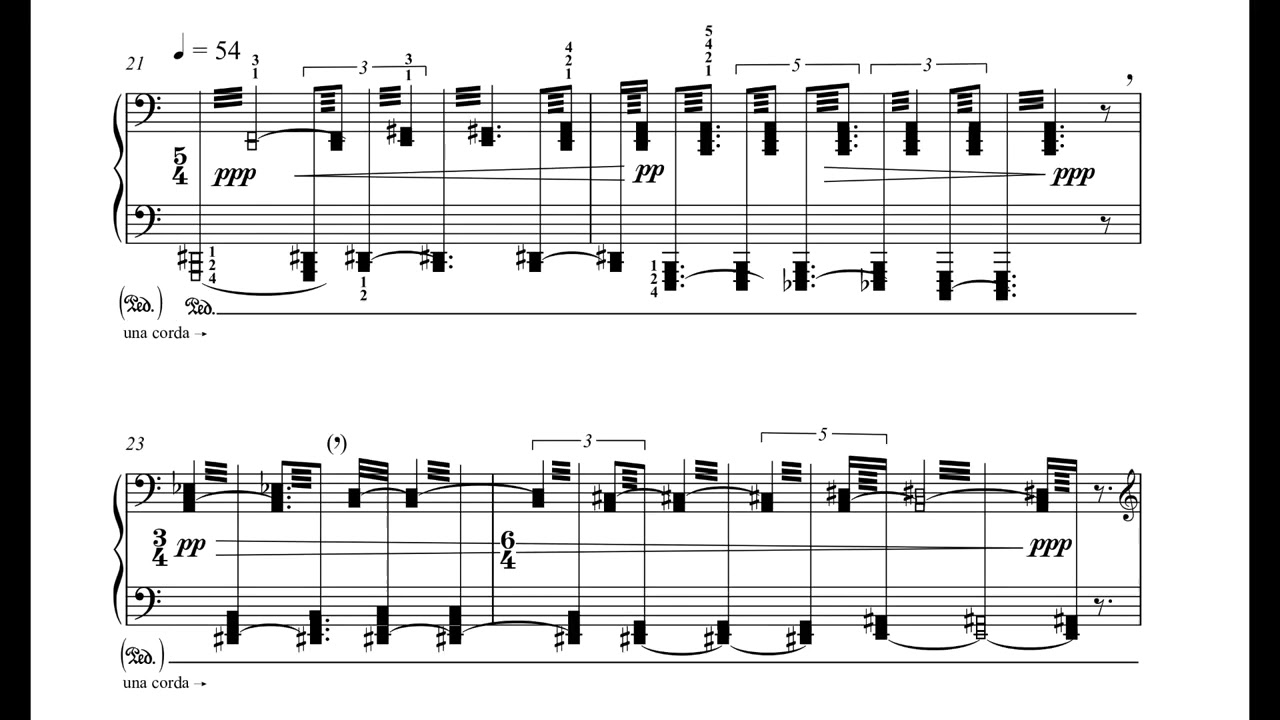
At the opening, a fine line of notes appears in the piano’s highest register.
From a distance, pitch loses its outline and becomes something like light or timbre. Almost immediately, however, the line descends and seems to move towards us. What had been a faint gesture, a single presence or colour, begins to reveal individual pitches and intervals, repetitions and points of friction.
Intriguingly, an examination of the pitch classes suggests that this sensation of coming into focus is present in the pitch structure as well.
The brief opening phrase already contains around ten different pitch classes. But dispersed across the piano’s highest register, they sound less like distinct pitches than a distant shimmer.
In the next phrase, the register drops sharply, while the pitch-class collection contracts to around seven.
As the sound comes closer, then, it is not only the register that changes. Pitch space itself gradually narrows into focus.
After the introduction of a low-register cluster, pitch comes further to the fore in the section of linear motifs that follows. Certain notes, including F, occur more frequently, while local relationships involving semitones and minor thirds become more apparent. In the distant view, many notes had dissolved into a single field. Seen close up, they emerge as relationships with their own internal colours and frictions.
This is not quite like looking at a distant landscape through a telescope.
As the distance changes, the very way in which “sound” exists seems to change with it.
What was timbre from afar becomes pitch up close.
And the device of revealing a sound’s identity returns in another form.
As if interrupting the linear music, a cluster-like tremolo begins to stir in the piano’s low register. By ear, its identity is uncertain.
But the score shows that this movement is no shapeless mass of sound. Both hands are notated around a framework of fifths. Within what we hear as a cluster, there is already a clear intervallic structure: the skeleton of something we might call a chord.
Eventually, we may even begin to sense a triad within it.
Yet the sound does not gradually turn into a triad.
At one moment, in a higher register, a bare tonal triad is struck without warning.
What had been an elusive presence suddenly appears before us as an object that anyone can recognise—as though it had undergone a mutation.
Again, it is not simply the pitch material that changes.
The same kind of intervallic relationship can exist at one moment as an unidentified texture and at another as a clearly recognisable chord. Its very mode of appearance shifts.
At the opening, the register descended and pitch space contracted, allowing “pitch” to emerge gradually from a distant “timbre.”
Here, by contrast, the music rises out of an indistinct movement and leaps over the process of transformation. A “triad” suddenly appears as an object.
Gradual focusing and abrupt manifestation.
The methods are entirely different, yet something about the experience is shared: the “identity” of a sound appears or disappears according to distance and the way we perceive it.
Towards the end of the piece, this seemingly fixed object is repeated insistently. Yet a note cuts into the clearly defined chord and refuses to be absorbed by it—something like an 'avoid note'. Brought forcefully into the foreground at *ff*, it makes the sound feel as close as it could possibly be. Psychologically, however, it pushes the listener away.
The title *fardanceCLOSE*, then, may suggest more than music moving back and forth between distance and proximity.
Hearing a sound from afar and hearing it up close intersect with psychological distance and closeness. As these relationships cross, even what we take ourselves to be hearing as “sound” changes. Perception is twisted on several levels at once.
In this short work, Czernowin unsettles more than our habitual sense of where a sound is located—of what it means for something to be near or far.
She unsettles the more basic certainty on which that sense depends: that we know what it is we are hearing.